The Flavor System of Japanese Tonkotsu Ramen: Five Core Elements & the Logic Behind the Craft
What makes a great bowl of tonkotsu ramen so irresistible? The answer lies in the precise collaboration of five independent modules. This article will help you understand the architecture of ramen flavor from first principles.
Japanese ramen is far from a rough "throw everything in a pot and boil" affair. On the contrary, a standard bowl of Japanese ramen follows a strict modular assembly logic — five core elements are prepared independently, then combined in a specific sequence at the very moment of serving. This "decoupled design" gives the ramen craftsman (shokunin) precise control over flavor, and is the fundamental reason Japanese ramen stands apart from most noodle soups around the world.
Using the most iconic Hakata tonkotsu ramen as the main thread, this article systematically deconstructs the five core elements of the ramen flavor system, the assembly workflow, and the underlying umami science. Whether you are a food-service professional, an ingredient buyer, or simply curious about Japanese cuisine, you will gain a clear understanding of the logic behind ramen craftsmanship.
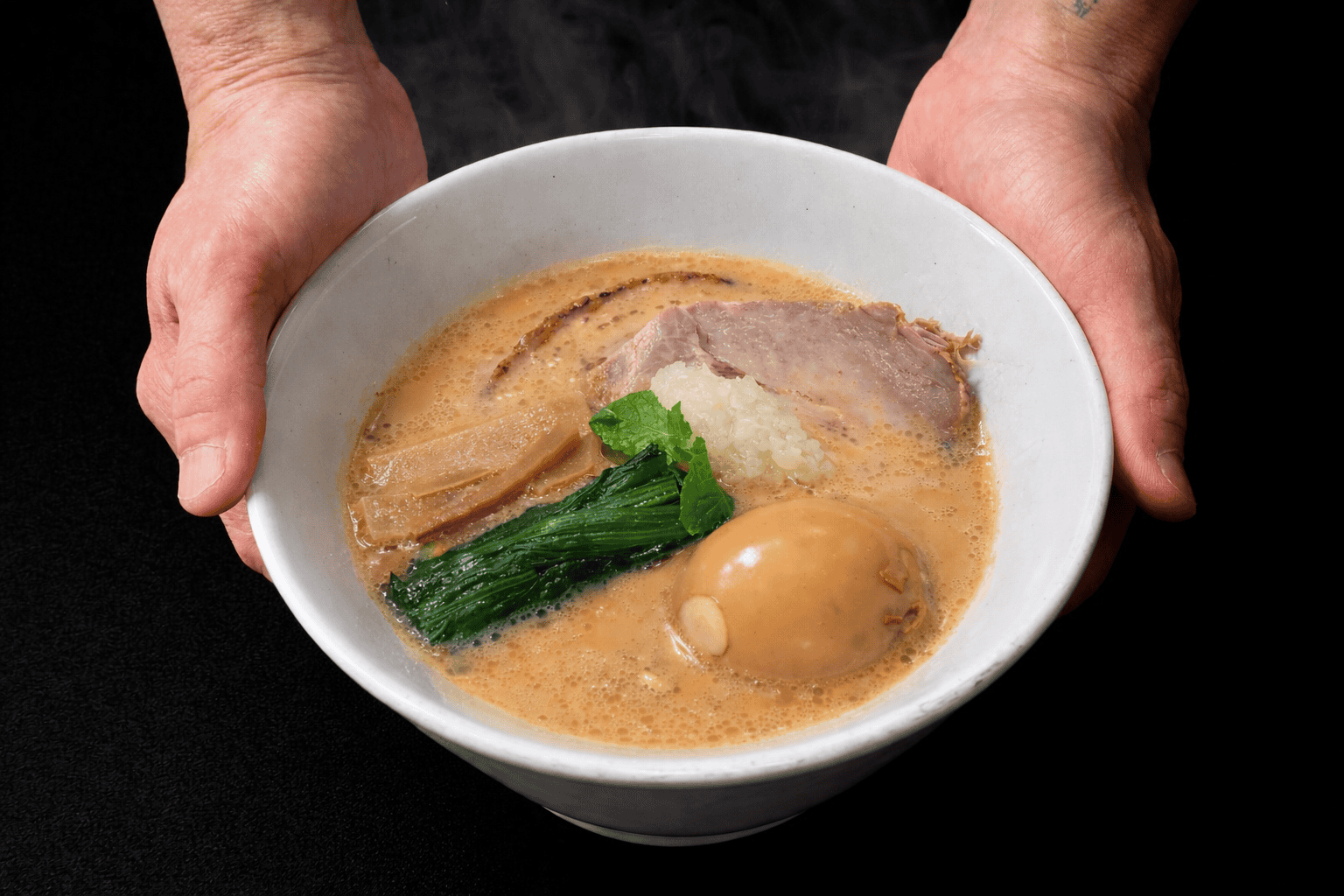
I. The Five Core Elements of Ramen
A complete bowl of Japanese ramen consists of five independent modules, each responsible for a distinct sensory function:
The physical foundation and thermodynamic carrier of the entire bowl. Through prolonged simmering, collagen and lipids are extracted from animal bones, building the body and texture of the broth.
The soul module that determines "what this bowl tastes like." It concentrates salt, free amino acids, and fermented flavors, and serves as virtually the sole source of sodium in the entire bowl.
The lipid layer floating on the soup surface, carrying fat-soluble aroma molecules. The very first ramen aroma you smell when you lean over the bowl comes largely from here. It also serves the physical functions of heat retention and noodle lubrication.
The carbohydrate matrix, which gains its distinctive yellow color and springy texture from alkaline mineral water (kansui). Hydration rate and shape directly determine how noodles interact with the broth.
Chashu pork, soft-boiled egg, bamboo shoots (menma), nori seaweed, green onions, and more. These are not decoration — they are functional components that provide acidity breaks, textural contrast, and palate resets.
II. Tonkotsu Paitan: The Physics of Collagen Emulsification
Tonkotsu paitan (pork-bone white broth) is the hallmark of Hakata ramen. Its milky-white, creamy appearance is not the result of any additive — it is the product of a precise colloidal chemistry process.
Pork bones (femurs, vertebrae, etc.) contain abundant collagen and fat. When the broth temperature exceeds 70°C to 82°C, collagen fibers — structured as triple helices — begin thermal denaturation: the molecular chains unwind and hydrolyze, dissolving into the water as gelatin. To achieve thorough conversion, the broth typically needs to be maintained at a sustained, vigorous rolling boil for 12 to 24 hours.
The vigorous boil provides more than just high temperature — it generates powerful physical shearing forces. This turbulence tears bone-marrow fat into microscopic droplets. These droplets intensely scatter light, rendering the broth opaque and milky white. Meanwhile, the gelatin molecules dissolved in the broth act as natural emulsifiers, adsorbing onto the surface of fat droplets to form a protective film that prevents oil-water separation and maintains long-term emulsion stability. This is why thick tonkotsu broth turns into a jelly when refrigerated — the gelatin network gels at low temperature, locking in both lipids and water.
III. Tare: Defining "What This Bowl Tastes Like"
Because ramen broth is simmered entirely without salt, the tare becomes virtually the sole source of sodium for the whole bowl, as well as the vehicle for delivering fermented flavors and free amino acids. Based on their primary components, tare recipes fall into three major schools:
| Tare Type | Key Flavor Compounds | Flavor Profile | Classic Pairings |
|---|---|---|---|
| Soy Sauce (Shoyu) | Glutamate, higher alcohols, organic acids | Rich and layered, combining caramel notes with deep fermented complexity | Versatile across all broth types, especially chintan |
| Salt (Shio) | NaCl, trace minerals | "Subtractive aesthetics" — minimal seasoning lets the broth's true character shine | High-quality chintan, seafood-based broths |
| Miso | Lactic acid, peptides, abundant glutamate | "Additive aesthetics" — bold fermented tang with nutty undertones | Heavy paitan broths, especially Hokkaido-style |
In practice, a ramen shop's tare is never a single off-the-shelf soy sauce or miso. Craftsmen typically blend three to five soy sauces from different origins and with different characteristics — for example, using koikuchi (dark) soy sauce to build a rich base and barrel-aged soy sauce to layer in aroma — then add mirin, sake, kombu, and katsuobushi (bonito flakes), heat-reduce the mixture, and finally age it under high-salinity conditions for several weeks to achieve a rounded, profound flavor. For Hakata tonkotsu ramen, the tare is usually extremely simple — primarily salt-based or very light soy sauce — letting the rich bone-marrow flavor dominate.
IV. Umami Synergy: The Biochemical Code Behind Ramen's Addictiveness
The reason Japanese ramen can trigger such intense gustatory pleasure lies in umami synergy. Since Professor Kikunae Ikeda isolated glutamate from kombu in 1908, scientists have subsequently identified two other key umami substances: inosinate (IMP), found in katsuobushi and meat, and guanylate (GMP), found in dried shiitake mushrooms.
When tasted individually, each produces only a moderate umami sensation. But when glutamate and inosinate are present simultaneously in the oral cavity, the perceived umami intensity skyrockets exponentially — at a 1:1 ratio, perceived intensity can reach 7 to 8 times that of either compound alone.
In a bowl of tonkotsu ramen, this synergy is systematically engineered: the pork-bone broth provides abundant inosinate, the soy sauce or miso in the tare provides glutamate, and if kombu or dried shiitake are also incorporated into the broth, guanylate enters the equation as well. This is why many premium ramen shops employ the double-soup technique (Double Soup) — blending animal-based and fish-based broths — which is essentially the deliberate construction of an optimal umami molecule ratio in a liquid medium.
V. Aromatic Oil & Noodles: Shaping Aroma and Physical Soup Pickup
Aromatic Oil — The "First Bite of Ramen" You Smell
Up to 80% of what we perceive as "flavor" actually comes from the olfactory system, with only 20% from the taste buds on the tongue. Aromatic oil floats on the soup surface, continuously releasing fat-soluble aroma molecules driven by heat — the moment you lean toward the rim of the bowl, the first volatiles entering your nasal cavity come from this oil layer. Hakata tonkotsu ramen typically relies on the micro-droplets of pork fat within the broth itself for aroma. Some shops add mayu (black garlic oil) — a deep-black lipid produced by controlled charring of garlic at high temperature, yielding a distinctive smoky bittersweet note. In addition, the aromatic oil layer acts as a physical insulator, slowing heat dissipation from the broth.
Noodles — The Physical Bridge Between Broth and Mouthfeel
Ramen noodles use kansui (alkaline mineral water) to push the dough's pH into the strongly alkaline range, triggering three key changes: flavonoid color-shift produces the golden hue, deep cross-linking of gluten proteins creates springy chewiness, and a dense protein network retards starch gelatinization, extending the noodle's resistance to over-softening. The noodle's hydration rate determines how it interacts with the broth — Hakata tonkotsu ramen uses ultra-thin straight noodles with very low hydration, where the tiny gaps between strands form a capillary network that precisely wicks the high-viscosity broth into the interstices. This is also why the "kaedama" (extra noodle) system exists — ultra-thin noodles soften rapidly in hot broth, so diners eat them in successive portions.
VI. Final Assembly: A Precision Sequence Completed in 10 Seconds
The assembly of all modules at serving follows a strict physical logic and is typically completed within 10 seconds:
Approximately 30 ml of room-temperature tare and ~15 ml of aromatic oil are poured into the bottom of a preheated empty bowl. The tare settles at the very bottom, providing the salt and umami foundation for subsequent mixing.
Room Temp · Bowl Bottom LayerApproximately 300–350 ml of piping-hot unsalted broth is poured into the bowl, using the force of impact for instant mixing. The broth-to-tare volume ratio is typically around 10:1, ensuring salinity stays within the ideal range.
80°C–95°C · Impact MixingCooked and thoroughly drained alkaline noodles (~130–140 g) are placed into the broth and folded into shape. The noodles immediately begin capillary interaction with the broth.
Noodles in Broth · Absorption BeginsChashu, soft-boiled egg, menma, nori, green onions, and other toppings are placed atop the noodles. Their positions are designed with both visual appeal and functional purpose in mind.
Visual Presentation · Functional LayoutVII. The Temperature Curve: Why Ramen Must Be Eaten Hot
When served, ramen broth temperature is typically 80°C or even 95°C. This extreme thermal energy drives volatiles from the aromatic oil into a concentrated vapor plume, maintains low viscosity of gelatin and lipids, and sets the temporal axis for the entire sensory experience of the bowl.
Molecular physiology research reveals that the TRPM5 ion channel on umami-sensing taste cells is highly temperature-sensitive — at extremely high temperatures, the umami signal is actually partially suppressed. However, when broth temperature falls to 15°C–35°C, the channel opens fully and umami perception peaks. This explains why many diners cannot resist draining that last mouthful of warm broth from the bottom of the bowl.
VIII. Summary & Extensions: From Tonkotsu Ramen to Tsukemen
To recap, the flavor system of Japanese tonkotsu ramen can be distilled into a clear underlying logic: the soup base builds body and texture, the tare delivers salt and flavor identity, the aromatic oil constructs an olfactory barrier at the liquid surface while insulating heat, the noodles achieve precise broth interaction through kansui cross-linking and hydration control, and the toppings provide palate resets and textural contrast. The independent preparation and terminal assembly of these five modules ensures that every single bowl achieves consistent flavor precision.
Even more noteworthy is that this five-element flavor system is not exclusive to tonkotsu ramen — it is a transferable, extensible universal framework.
Take tsukemen (dipping ramen), which has surged in popularity in Japan in recent years, as an example: the broth and noodles are served completely separately, the tare concentration is dramatically increased (because the noodles pick up far less broth per dip than in regular ramen), the aromatic oil ratio is adjusted accordingly, and the noodles use thick, high-hydration strands for standalone chewiness and cold-eating adaptability. The roles of the five modules remain unchanged — what changes are the parameter settings and combination methods of each module.
The same logic extends to abura soba (oil noodles), tantanmen (dandan noodles), and other variants. Understanding the underlying framework of this flavor system means understanding the production logic of an entire category — not merely memorizing one recipe.
Need Authentic Japanese Ramen Ingredients?
From Hokkaido kombu and Kagoshima katsuobushi to ramen-grade flour, soy sauces, and miso in various specifications — tell us your menu direction and receive a tailored ingredient solution.
Get Your Ingredient Plan →